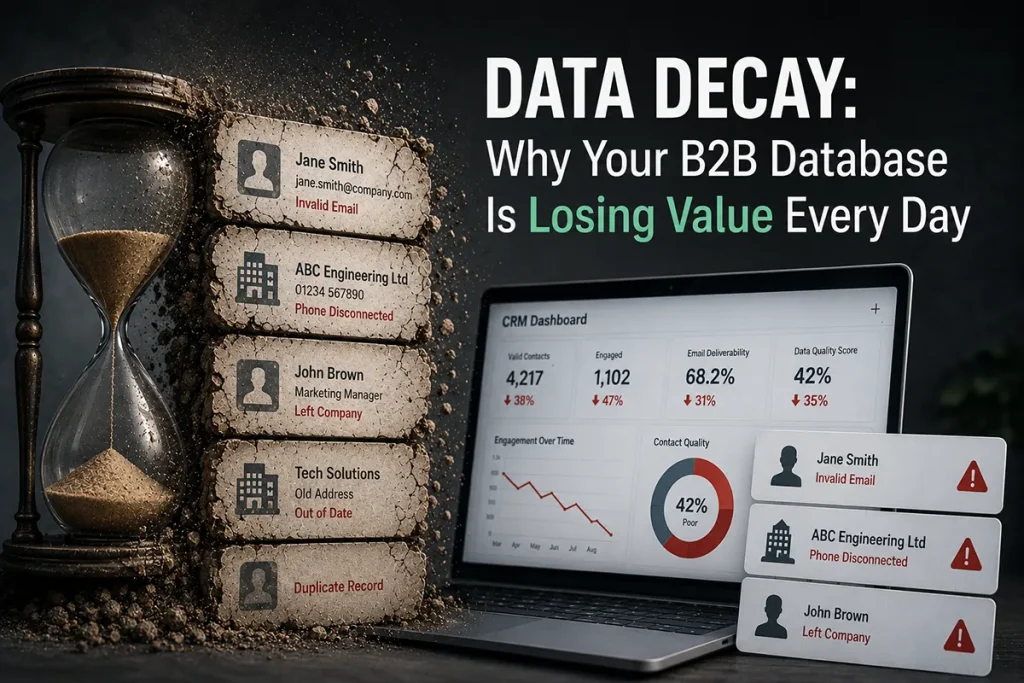
B2B data does not stay accurate for long. The moment a contact enters your CRM or marketing database, it begins to age.
People change roles. Companies restructure. Email addresses become invalid. Phone numbers stop working. Buying committees move on. A record that was accurate six months ago may already be out of date today.
This gradual loss of accuracy is known as data decay.
For sales and marketing teams, data decay can quietly undermine performance. A database may look complete on the surface, but if the information inside it no longer reflects the real market, teams risk targeting the wrong people, wasting budget, and making decisions based on outdated assumptions
Key data quality terms explained
When people talk about poor-quality data, several terms are often used interchangeably. They are related, but they do not mean quite the same thing.
Data decay is the gradual loss of accuracy over time. In a B2B database, this might happen when a contact changes role, a company restructures, an email address becomes invalid, or a phone number is no longer in use.
Data rot refers to redundant, obsolete, or trivial information that clutters a database. This could include duplicate records, old event leads, inactive contacts, or fields that no longer serve a clear purpose.
Data degradation happens when data becomes incomplete, inconsistent, or unreliable, often because of system issues such as poor integrations, failed imports, rushed migrations, or incorrect field mapping.
Data hygiene is the ongoing process of keeping data accurate, complete, relevant, and usable. It includes regular audits, validation, deduplication, enrichment, and removing records that no longer add value.
Why data decay matters
Data decay affects every part of the revenue process.
Sales teams may spend time chasing contacts who have left the business. Marketing campaigns may be sent to people who no longer match the target audience. Reports and forecasts may be built on records that are technically present but commercially unreliable.
The result is often lower response rates, higher bounce rates, weaker segmentation, and less confidence in pipeline data.
It also creates wider business risks. Poor-quality data can affect decision-making, customer relationships, operational efficiency, compliance, and the performance of digital tools that rely on accurate information.
The financial cost of bad data
Poor-quality data has a direct commercial impact. It wastes time, budget, and opportunity.
For sales teams, bad data means more time spent chasing contacts who have moved on, calling incorrect numbers, or following up with companies that no longer fit the ideal customer profile.
For marketing teams, it can mean campaigns being sent to outdated segments, higher bounce rates, weaker engagement, and wasted media spend.
The cost is not always obvious in a single report, but it builds up quickly. Bad data can lead to:
- wasted sales time
- poor campaign performance
- damaged sender reputation
- inaccurate reporting
- unreliable forecasting
- inflated pipeline figures
- missed opportunities
- lower confidence in CRM data
There is also a strategic cost. If senior teams are making decisions based on incomplete or outdated information, they may be planning around a version of the market that no longer exists.
In this sense, bad data is not just an admin problem. It is a revenue problem.
The GDPR risk of outdated data

The cost of bad data is not limited to lost time and wasted marketing spend. For businesses operating in the UK and Europe, outdated or inaccurate personal data can also create GDPR risks.
B2B contact data may feel like “business information”, but if it identifies an individual, for example by name, email address, job title, phone number or employer, it is still personal data.
That means organisations have a responsibility to ensure it is accurate, relevant, and kept up to date where necessary.
This matters because records can become inaccurate very quickly. A contact may leave a company, move into a different role, or no longer have any relevant relationship with your organisation. If those records remain in your CRM or marketing database without review, they can become more than a data quality issue. They can become a governance and compliance concern.
Poor data hygiene can also make it harder to demonstrate good data management practices. For example, businesses may struggle to show why a record is still being held, whether it remains accurate, or whether it should be refreshed, suppressed, or removed.
Practical steps to reduce GDPR risk include:
- Regularly review and clean CRM and marketing data.
- Remove or suppress records that are no longer relevant.
- Validate contact details before using them in campaigns.
- Maintain clear consent, preference, and suppression records.
- Ensure data is only kept for as long as there is a valid reason.
- Use compliant data sources and enrichment processes.
- Document how data quality and retention decisions are managed.
Good data governance is not just about avoiding risk. It also supports better marketing, stronger customer relationships, and more trusted decision-making.
The AI factor

As more businesses introduce AI into sales and marketing workflows, data quality becomes even more important.
AI tools rely on the information they are given. If CRM data is outdated, incomplete, or inaccurate, AI-driven scoring, routing, segmentation, and personalisation will reflect those weaknesses.
In simple terms: poor data does not become better because AI is applied to it. It often becomes a faster route to poor decisions.
For example, if an AI tool is using outdated job titles, old engagement data, duplicate records, or inaccurate company information, its recommendations may be flawed from the start. It may prioritise the wrong accounts, personalise messages using incorrect details, or support forecasting based on unreliable inputs.
Clean, current, well-structured data is now essential for any organisation hoping to use AI effectively in its sales and marketing activity.
How to prevent data rot and reduce data decay
Data decay cannot be avoided completely, but it can be managed. The key is to treat data quality as an ongoing business process rather than an occasional clean-up exercise.
A good starting point is to audit your existing CRM and marketing database. Look for duplicate records, missing fields, bounced email addresses, inactive contacts, outdated job titles, and records that have not been reviewed for some time.
This gives you a clearer view of where poor-quality data may already be affecting sales, marketing, reporting, and compliance.
Businesses should also validate data at the point it enters the system. Web forms, event lists, downloads, manual uploads, and third-party sources can all introduce errors. Checking email addresses, standardising fields, and making sure consent and preference data is captured correctly can prevent problems from spreading through the database.
Regular cleansing is also important. Duplicate records should be merged, obsolete records removed or suppressed, and contacts that can no longer be verified reviewed before they are used in campaigns.
For GDPR purposes, it is especially important to ensure that personal data is accurate, relevant, and not kept for longer than necessary.
Where possible, businesses should use trusted enrichment and verification processes to keep contact and company information up to date. This can help identify job changes, invalid email addresses, missing information, and changes to company details before they damage campaign performance or sales activity.
Finally, data quality should not sit with one person or department. Sales, marketing, customer service, and operations teams all touch customer and prospect data. Clear internal processes can help make sure that when someone spots incorrect, duplicated, or outdated information, it is updated properly rather than ignored.
Practical steps include:
- Audit CRM and marketing data regularly.
- Remove duplicate, obsolete, and irrelevant records.
- Validate email addresses and phone numbers before use.
- Standardise fields and data entry formats.
- Review inactive contacts and old campaign lists.
- Maintain accurate consent and suppression records.
- Use compliant data sources and enrichment tools.
- Train teams to update records when they spot changes.
- Set a regular data retention and cleansing schedule.
The aim is not to build a perfect database. It is to build a reliable one that is accurate enough to support better decisions, stronger campaigns, more productive sales activity, and responsible data governance.
A living database, not a static asset
The key is to treat B2B data as a living asset.
Markets change. Companies evolve. People move. A database that was accurate six months ago may already be steering teams in the wrong direction.
By keeping data fresh, accurate, and well-governed, businesses can improve campaign performance, support better sales conversations, strengthen compliance, and build a more reliable foundation for AI.
Data decay may be inevitable, but its impact does not have to be.
Talk to us at i-4business to find out how you can avoid the risks of data decay with a subscription to our accurate, up-to-date and fully GDPR compliant EMEA enterprise data platform.
Call us on 01252 367400 or email support@i4b.com